

The WordPress Admin Bar Editor That Gives You Full Control
The WordPress toolbar sits at the top of every page you load as a logged-in user, and by default it fills up with plugin notices and links you never click. Admin Bar Editor fixes that. Hide what you do not need, rename what confuses your clients, and keep the shortcuts you actually use.
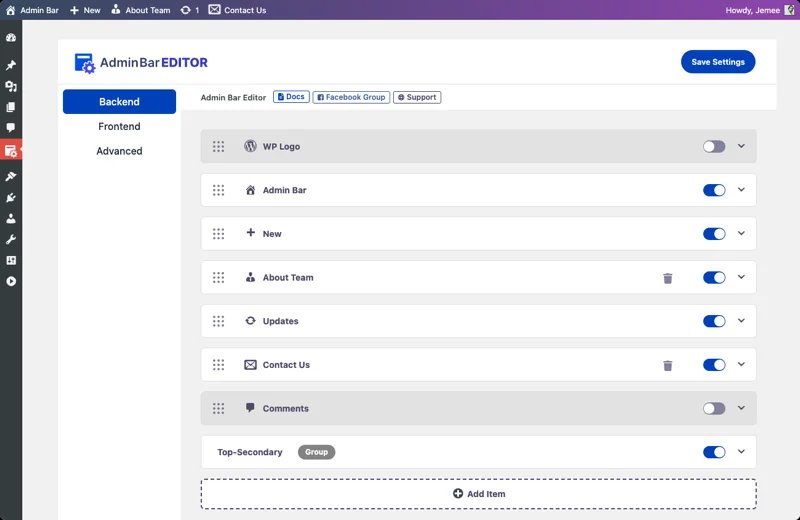
Trusted by 3,000+ WordPress users and featured by the top industry leaders.




Features at a Glance
A quick look at what the plugin does. Each feature solves a specific toolbar problem
that most WordPress sites run into sooner or later.

Visibility Control
Hide the WordPress admin bar for the whole site with one toggle, or keep it on for admins while removing it for Customers. Add conditions by role or by specific username when you need finer control.

Overflow Fix
Stop your toolbar from wrapping to two lines on smaller screens. Strip out the items plugins keep pushing in, and the bar goes back to one clean row that fits on any monitor.

Custom Links and Menus
Add top-level menu items and submenu entries pointing to any URL. Handy for client shortcuts, support docs, external tools, or an internal dashboard your team opens ten times a day.

Frontend Toolbar Control
Kill the frontend admin bar globally, or keep it on and hide only the items you do not want logged-in visitors seeing. Cleaner front end, no exposed admin shortcuts.

Hide Items by User Role
Show Editors a different toolbar than Authors. Show Customers a different bar than Shop Managers. You set the rules per role without touching theme code.

Icon Customization
Replace any toolbar icon with an uploaded image or a different Dashicon. Swap the WordPress logo for your agency logo and the bar stops looking like stock WP.

Drag-and-Drop Ordering
Reorder backend and frontend items by dragging. No shortcodes, no filter hooks, no child theme required. Drag an item where you want it, hit save, done.

Sub-Item Support
Add submenu items under existing or new menus. You can group related shortcuts so the top bar stays short while deeper items are still one hover away.

Menu Renaming
Rename any admin bar menu title. Change "Howdy, John" to "Hi, John" or drop the greeting entirely. Rename "New" to "Create" if that matches how your team talks about it.
Every Feature Explained: Real Benefits and Use Cases
What each feature does, when you would reach for it, and the practical wins you get out of it.
Remove or Replace the Logo
The WordPress logo sits in the top-left corner of every admin bar, and on a client site that tiny logo is usually the first thing that gives away the platform. Fine for a personal blog. Not great for agency work, SaaS dashboards, or anything white-labeled. Admin Bar Editor hides the logo entirely or swaps it for an image of your choice, with no CSS hacks needed.
Hide the Admin Bar Completely
Not every logged-in user benefits from seeing the toolbar. Customers on a WooCommerce store, members on a community site, and students on an LMS rarely have a reason to click those links, and the bar often just gets in the way of the site header. One toggle hides the frontend bar globally. Pro adds per-role and per-user control on top of that.
Hide Toolbar Items by User Role
Different roles want different things in the toolbar. Authors mostly use New Post and Edit. Shop Managers live inside WooCommerce. Subscribers need almost nothing beyond their profile link. Role-based hiding gives each role a bar that matches their actual job, and the side benefit is fewer support tickets that start with "where do I click to…".
Disable Toolbar by Specific Username
Role-based rules cover most situations, but occasionally you need a one-off exception. A freelance contractor with Administrator access might not need the full bar while they are editing. A VA account might see less than the rest of your admin team. Username-level rules handle the edge cases that pure role-based logic cannot.
Modify or Remove the Howdy Admin Text
The "Howdy" greeting has been in WordPress since 2003, and it is one of those details that quietly dates a client dashboard. Admin Bar Editor lets you change the greeting to anything (or remove it completely) so the profile menu stops reading like it belongs to someone else's product.
Add Custom Links to the Admin Bar
Think about the admin pages you open the most. The plugin settings three menus deep. The support inbox you check every morning. The external tool you switch to a dozen times before lunch. Admin Bar Editor promotes any of them to the top-level toolbar, and the click count on your most-repeated workflows drops almost immediately.
Drag-and-Drop Toolbar Ordering
The default item order is whatever WordPress and your installed plugins decided on, and it is almost never the order you actually work in. Admin Bar Editor lets you grab any item and drop it where it makes sense. The things you click a hundred times a day end up where your mouse already sits; the items you barely use slide to the end of the bar.
Third-Level Submenu Items
Flat toolbars get crowded quickly once you start adding custom links. Third-level submenus let you group related shortcuts under a parent item, which keeps the top bar short while every link is still one hover away. This is how you build a toolbar that can grow with the site instead of turning into a wall of icons.
Modify Every Admin Bar Menu Item
Past the hide/reorder basics, Admin Bar Editor lets you rename any menu item, swap its icon, and adjust its visibility. So every label can match your client's vocabulary, every icon can match your brand, and every item can appear or disappear based on role or user. It is about as granular as toolbar editing gets without writing code.
Change the Admin Bar Position
WordPress puts the toolbar at the top of the screen, directly under the browser address bar and often overlapping where site headers want to sit. That crams a lot of heavy UI into one strip of vertical space. Moving the bar to the bottom fixes it. The top of the page goes back to being about your content, and the toolbar behaves more like a persistent footer-style action bar.
Style Customization Made Easy
The default admin bar is black with white text. Functional, but not branded. Pro opens up style controls for the background color, gradient backgrounds, text color, dropdown appearance, and the "New" button color. Every piece of the toolbar can be tuned so the bar stops feeling like a WordPress leftover and starts feeling like part of your product.
Simple Pricing for Every Team Size
Over 3,000+ Active users & growing. Admin Bar Editor plugin lets you enhance branding, improve your workflow and much more. Choose a suitable plan and start customizing your Admin Bar.
Personal
29
/ Year- 5 Website
- Hide Admin bar in 1 Click
- Role-Based Option Hiding
- Icon Customization
- Add New Links
- Drag-and-Drop Reordering
- Translation Ready
- RTL Ready
- 1 year Update and Support
Business
39
/ Year- 15 Websites
- Hide Admin bar in 1 Click
- Role-Based Option Hiding
- Icon Customization
- Add New Links
- Drag-and-Drop Reordering
- Translation Ready
- RTL Ready
- 1 year Update and Support
Agency
99
/ Year- 100 Website
- Hide Admin bar in 1 Click
- Role-Based Option Hiding
- Icon Customization
- Add New Links
- Drag-and-Drop Reordering
- Translation Ready
- RTL Ready
- 1 year Update and Support
Lifetime Bundle
799.00
/ Lifetime- Use on up to Unlimited Websites
- Lifetime Updates and Support
 WP Adminify
 Loginfy
 WP Spotlight
 Header and Footer Scripts
 Quick Menu
 Admin Bar Editor
 Admin Columns Editor
Start with the free version on WordPress.org. Upgrade to Pro when you need role-based visibility, custom menus, or the style controls.
Free vs Pro: What You Get
| Free | PRO | |
| Toggle backend items | ||
| Drag-and-drop reordering | ||
| Disable frontend bar globally | ||
| Admin bar item position | ||
| Rename Admin Bar items | ||
| Rename howdy Text | ||
| Hide bar by user role | ||
| Hide bar by specific username | ||
| Custom icon replacement | ||
| Background color and gradient | ||
| Custom text color | ||
| Dropdown styling | ||
| Add custom top-level menu items | ||
| Add custom submenu items | ||
| "New" button color control |
Real stories we have heard from our users
From individuals to agencies, most of our users use the Admin Bar Editor plugin to create a personalized toolbar.
A lot of them are highly satisfied with our support and feature.

I’m not easily installing plugins, but this one is seemingly one of the necessary and really useful plugins.

WordPress.org

Amazing Experience! Support Absolutely lovely team, support and user experience!

WordPress.org
Amazing Plugin! Outstanding Support! This plugin is superb with great support. Purchasing this plugin as it’s a must buy.

Agency Owner
Outstanding Plugin & the support. I had faced an issue of this plugin & the support was outstanding.

WordPress.org
Frequently Asked Questions
The questions we hear most often from people evaluating the plugin.
Can I hide the WordPress admin bar on the frontend?
Yes. You can disable the frontend admin bar globally with a single toggle, or keep it visible and control which items appear on it. Both options are part of the free version.
Can I hide the admin bar only for certain users or roles?
Yes, that is a Pro feature. You can hide the frontend admin bar for specific roles (like Subscriber or Customer) or individual usernames, while keeping it enabled for administrators and editors.
Can I add custom links or menus to the admin bar?
Yes, with Pro. Add new top-level menu items or submenu entries pointing to any URL you want. It works for client shortcuts, documentation links, external tools, or an internal dashboard your team opens daily.
Does Admin Bar Editor change WordPress core files?
No. The plugin works through standard WordPress hooks and filters, so it never touches core files. Deactivate it and the toolbar goes back to default with nothing left behind.
Will this plugin slow down my site?
No. It is lightweight and only affects toolbar markup for logged-in users. There is no impact on front-end page load for visitors, and the backend overhead is small enough to be unnoticeable.
Is it compatible with my theme and other plugins?
Yes, as long as your theme uses the standard WordPress admin bar API (nearly every modern theme does). It also supports toolbar items that plugins add, so you can toggle or reorder those from the same interface.
Can I style the admin bar differently on backend and frontend?
You manage the two toolbars in separate tabs, so items can be enabled or disabled independently. The position setting and the Pro style controls apply across both views at the same time.
What happens to my settings when I update or deactivate the plugin?
Your configuration is stored in the database and kept through updates. If you deactivate the plugin the default admin bar returns, and when you reactivate, your saved layout and options come back exactly as they were.
How do I upgrade from the free version to Pro?
Grab a Pro license from this page, download the Pro plugin ZIP, and install it alongside the free version. Activate your license key and the Pro features appear in the settings panel right away.
Can I use one license on multiple client sites?
Yes. Personal covers 5 sites, Business covers 15, and Agency covers 100. If you run more than that, the Lifetime Bundle gives you unlimited sites plus six other Jewel Theme plugins.
Does it work with multisite networks?
Yes. Admin Bar Editor runs on both single sites and multisite installations. Each site in the network keeps its own toolbar configuration, so you can tune the experience per site.
Can I move the admin bar to the bottom of the screen?
Yes, and this one is in the free version. There is a position toggle that moves the bar from top to bottom, and the change applies to both backend and frontend at once.
Can I replace the WordPress logo with my own brand logo?
Yes. Pro's icon customization lets you replace the default WordPress logo with any image. It is one of the most requested features from agencies running white-label client work.
Can I change or remove the Howdy text?
Yes. Pro lets you rename the greeting, replace it with a custom phrase, or remove it entirely. Small branding touches like this add up when you are trying to make the dashboard feel like your own product.
Is there a refund policy?
Yes. Jewel Theme has a standard refund window on all paid plans. Check the refund policy page for the full terms before you purchase.
Where can I get support?
Free users can post in the WordPress.org support forum for Admin Bar Editor. Pro customers get priority support through the Jewel Theme help desk, which means faster responses and direct access to the development team.
Get Started with Admin Bar Editor Today
We offer the best WordPress Dashboard Customization and maintenance feature to our users.
Rebrand the admin panel of personal or clients Dashboard within minutes.
Total Downloads
Active Installations
Five Stars Ratings
Customer Satisfactions
